Feb 26, 2026

Executive Summary
Giza builds autonomous agents that manage DeFi positions on behalf of users. These agents monitor markets, execute strategies, rebalance portfolios, and compound returns—continuously, without human intervention.
This document explains how Giza creates value, captures revenue, and distributes that value to token holders. The architecture is designed for clarity: product usage drives fees, fees fund systematic buybacks, and staking provides utility through execution priority. Each layer has a distinct function. Together, they form a coherent economic system.
1. The Value Giza Creates
The Cognitive Labor Problem
The fundamental limiting resource in finance is cognition itself. The capacity to perceive a landscape, hold multiple variables in relation, and act coherently across time.
Market participants spend attention on monitoring positions, tracking rates across protocols, rebalancing allocations, and managing risk. These labor requirements are cognitive and they scale with market complexity, while human attention does not. The result: most participants either simplify their strategies (accepting suboptimal returns) or dedicate professional-grade resources (inaccessible to most).
Giza agents externalize this cognitive labor. Users deploy capital into agents that handle execution autonomously: continuous monitoring, autonomous rebalancing, risk management, and opportunity capture. The user sets preferences; the agent operates.
Three Tiers of Value
Giza's value proposition operates across three tiers of strategic reach:
Human-Possible (Convenience) Strategies a skilled DeFi user could execute manually, but would require constant attention and visibility. Giza provides the convenience of integrated automation without the operational burden.
Human-Difficult (Performance) Strategies requiring execution speed, multi-protocol coordination, or continuous optimization that exceed practical human capacity. Giza delivers performance improvements that individual attention cannot match.
Human-Inaccessible (New Capabilities) Strategies involving simultaneous multi-variable optimization, real-time risk arbitrage, or cross-chain coordination that no individual could execute manually at any attention level. Giza unlocks capabilities that didn't exist before.
Measurable Value
Value creation is quantifiable:
APR Delta: The difference in returns between passive holdings and agent-managed positions. This is measured through continuous backtesting comparing identical capital with and without Giza optimization.
Risk Reduction: Position management that responds to market conditions—deleveraging before liquidation thresholds, exiting positions before utilization spikes cause withdrawal delays.
Time Recovery: Cognitive bandwidth returned to users who would otherwise spend hours monitoring positions, evaluating opportunities, and executing transactions.
The APR delta serves as the primary pricing anchor. If Giza agents demonstrably improve returns by X%, value-based pricing follows.
2. How Giza Captures Value
Who Giza Serves
Giza serves anyone managing capital in permissionless markets who wants better outcomes without operational burden. This includes individual participants optimizing personal holdings, funds, treasury managers and DAOs deploying significant capital, and developers building applications where smart yield is a feature.
What varies across these users is not their identity but their requirements: how much control they want, how frequently they need execution, and how they prefer to access the system. Giza's capability tiers map to these requirements.
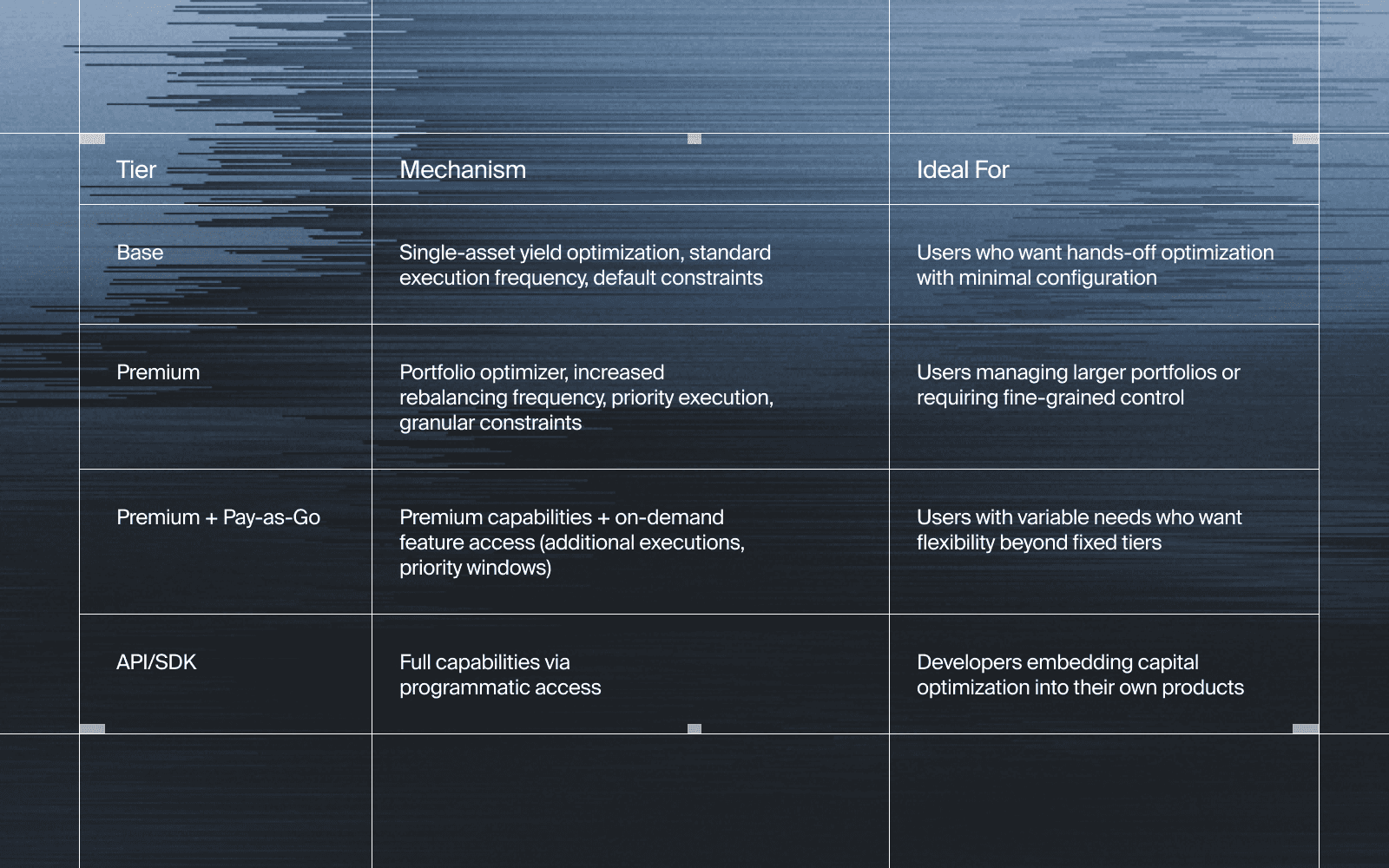
All tiers run on the same underlying intelligence. Premium unlocks additional capabilities within the same product.
Revenue Mechanics
Performance Fees A percentage of yield generated by agents. This aligns Giza's revenue with user outcomes: we earn more when users earn more. Fees are collected during the auto-compounding cycle, agents harvest reward tokens on behalf of users, swap them to the base asset, deduct the fee, and reinvest the remainder. The user never takes a separate action to pay; fee collection is embedded in an operation that already increases their returns. This mechanism, fee collection at auto-compounding, is a Giza agent native primitive that enables frictionless experience for the user and increased cash flow for the protocol.
Subscription Premium capabilities require subscription. This creates predictable revenue while gating access to higher-cost features, increased execution frequency, portfolio optimization, granular constraints. Subscriptions are a new primitive in DeFi, made possible by Giza's smart account architecture. Vault-based protocols treat all depositors identically; smart accounts allow per-user configuration, making differentiated access possible for the first time.
SDK/API Fees Developers integrating Giza's intelligence layer pay based on usage—capital under management, execution frequency, or API calls depending on integration pattern.
The Execution Surface as Payment Infrastructure
Traditional SaaS relies on subscription billing where users pay automatically, monthly or annually. Web3 users don't operate this way. They interact with protocols through discrete transactions, not recurring payment agreements.
Giza solves this through a structural advantage: agents execute transactions continuously on behalf of users. This execution cadence creates a natural surface for payment collection.
Each execution checkpoint can:
Verify the user's feature tier
Process accumulated fees
Check stake weight for priority calculation
Subscription fees are deducted during auto-compounding operations. Performance fees are taken when yield is realized. No separate billing infrastructure required.
The execution surface that makes the product work also makes the business model work.
3. How Value Flows to Token Holders
How does product success translate to token value? Giza's answer: systematic buybacks.
Systematic Buybacks
50% of protocol performance fees are allocated to a Buyback Reserve. This is a programmatic mechanism rather than a discretionary treasury management:
Revenue accrues from fees and subscriptions
A fixed ratio is allocated to buybacks
Buybacks execute automatically at defined intervals
Purchased tokens are removed from circulation
The mechanism is deterministic. As AUA grows and agents execute more transactions, revenue increases. As revenue increases, buyback volume increases. As buyback volume increases, sustained demand pressure on $GIZA increases.
Why This Works
Legibility: Investors and stakeholders can model the relationship between product metrics and token demand. More users → more fees → more buybacks → more demand. The flow is traceable.
Automaticity: Manual treasury operations introduce discretion, timing risk, and governance overhead. Systematic buybacks remove these variables. The mechanism executes regardless of market conditions or team decisions.
Alignment: Token value becomes a function of product utility, not speculation about future utility. The token captures a share of actual economic activity.
Buyback Ratio
The buyback ratio - what percentage of revenue flows to buybacks - requires balancing competing needs:
Higher ratio: Stronger token demand, clearer investor narrative
Lower ratio: More capital for growth, product development, market expansion
The appropriate ratio is not static. It is governed by two variables:
Coverage ratio. The ratio between buyback capacity and emission volume. Buybacks are only meaningful when tokens retired through purchasing outpace tokens entering circulation through emissions. As emissions contract toward zero (see Section X: Emissions) and revenue grows with AUM, the coverage ratio improves on both sides simultaneously.
Token price. The price at which buybacks execute directly determines retirement efficiency. At lower prices, every dollar of reserve retires more tokens. At higher prices, the same dollar retires fewer. This creates a structural incentive for accumulation during early phases: the reserve grows while conditions mature, and deployment at favorable prices maximizes the number of tokens permanently removed per dollar spent.
The buyback reserve accumulates continuously from the fixed revenue allocation. Deployment is the variable — gated by coverage ratio viability and executed with price awareness. The ratio itself becomes a function of stage, not a fixed political commitment.
4. Staking: Execution Priority
The Scarcity
Giza agents execute in sequentially. With thousands of agents operating, someone goes first and someone goes last. Currently, this ordering is determined by internal logic. But order matters:
First into a pool captures yield before subsequent deposits dilute APR
First out of a pool escapes before utilization spikes cause withdrawal delays or losses materialize
First to deleverage avoids liquidation cascades when collateral ratios shift—the agent that exits first exits cleanly; the agent that exits last may face slippage or full liquidation
Execution order is a scarce resource. Staking provides a transparent mechanism to allocate it.
The Mechanism
Staking $GIZA grants execution priority for your agents. Priority score is calculated from stake weight relative to other stakers, determining position in the execution queue.
Higher priority score = earlier execution in the queue.
Users can allocate stake across multiple agents. Small players with significant relative stakes achieve priority within their cohort. Large players staking more achieve higher absolute priority. Both behaviors are rational responses to the mechanism.
Stake-to-Priority Mechanics
The relationship between stake and priority is a design decision with multiple valid approaches:
Linear: Priority scales proportionally with stake. Simple, but allows large stakers to dominate completely.
Logarithmic: Diminishing returns to additional stake. Protects smaller stakers from complete marginalization.
Tiered: Discrete priority bands (Bronze/Silver/Gold). Clear thresholds but creates cliff effects.
Hybrid: Base priority from stake amount with multipliers for duration or other factors.
The optimal design depends on empirical data about execution contention frequency, alpha differential between queue positions, and community composition. We present this as an active design space to be rolled out in near future rather than a settled mechanism.
A Note on Resource Allocation
One perspective on this system: subscriptions and priority staking are both signals helping the protocol optimize resource allocation. Subscriptions signal minimum absolute resource requirements. Priority signals relative resource preferences when demand exceeds supply.
Since maximizing agent return also maximizes protocol performance fees, Giza is incentivized to ensure all agents are adequately resourced. The staking mechanism allocates priority during contention, it doesn't create artificial scarcity to extract rent.
This framing addresses a reasonable user concern: "Why do I have to pay extra for better yield when the protocol already takes a performance fee?" The answer: you don't pay for better yield; you pay for priority during periods when not everyone can execute simultaneously. The protocol's incentive remains return maximization for all agents.
5. Emissions
Giza has two emission paths: agent rewards and staking rewards.
Agent rewards supplement yields on agent-managed positions, accelerating capital growth on the platform. Staking rewards support the ecosystem, with 68 million $GIZA tokens are staked today, providing governance participation, voting power, and protocol commitment.
Both are also designed to evolve.
Agent rewards → capabilities. As Giza's capabilities expand to agent-native financial markets, the capabilities themselves become the reason to deploy capital. Each new capability absorbs a portion of the role that reward emissions currently play. Reward emissions contract as product-driven demand grows to replace them.
Staking rewards → product utility. As staking-based product features come online — execution priority, reduced fees, increased rebalancing frequency, premium capabilities — the utility of staking compounds. The reason to stake shifts from emissions to direct product benefit. Staking functionality transforms.
Both emission paths are designed to reach zero within six months through usage growth and product expansion.
The system scales. Revenue scales with AUA growth. Emissions contract as capabilities replace incentives and product features replace staking rewards. The coverage ratio improves from both directions simultaneously. This is the point where systematic buybacks activate at full effectiveness and the flywheel engages.
6. The Flywheel
How the System Reinforces Itself
Each component of Giza's economics feeds the next:
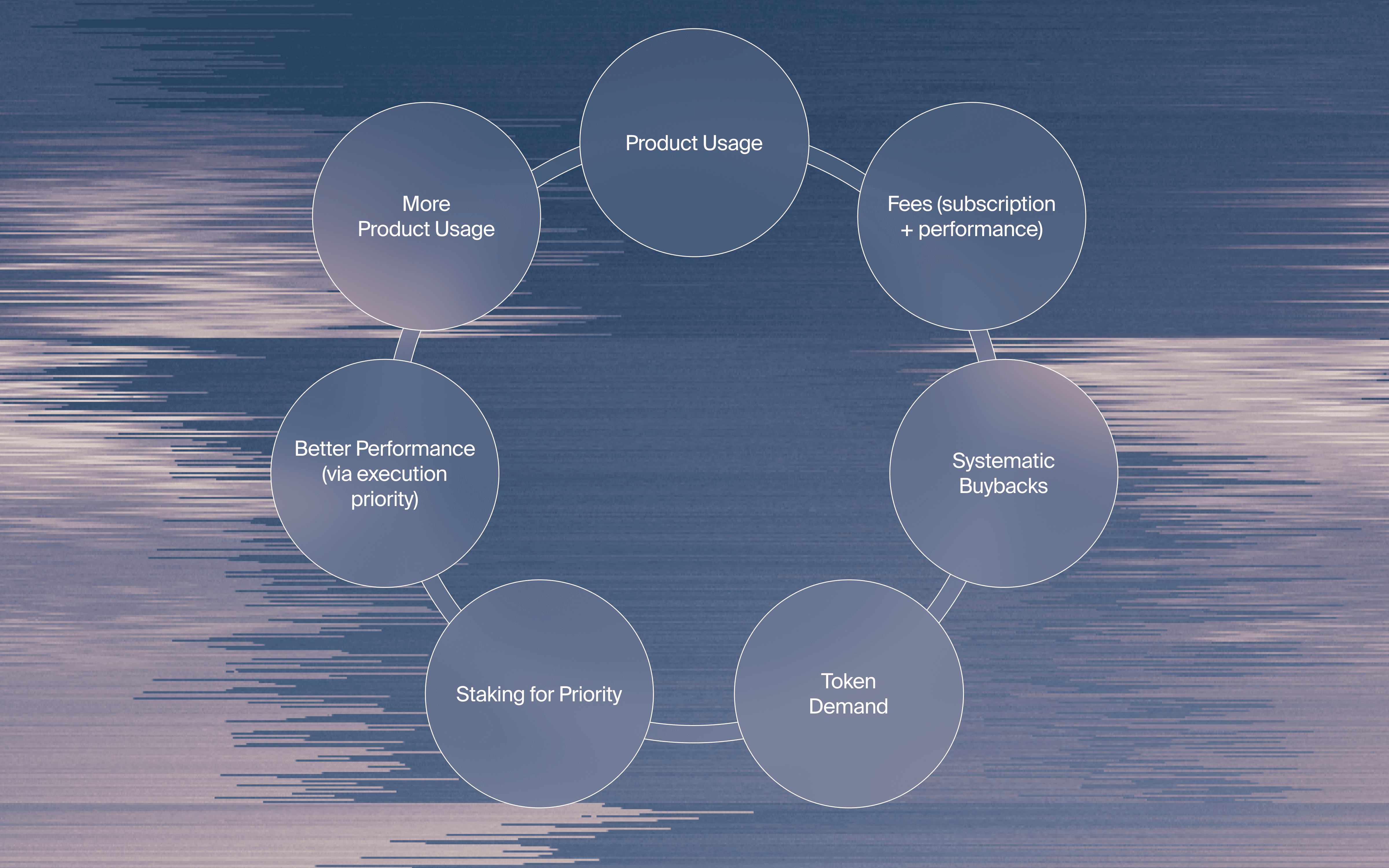
The flywheel is not theoretical. Each step has a concrete mechanism:
Users deploy capital into Giza agents
Agents execute strategies, generating yield
Fees are collected during execution cycles
A portion of fees automatically purchases $GIZA
Users stake $GIZA to gain priority in the execution queue
Priority stakers capture more alpha and better risk protection
Superior performance attracts more users to deploy capital
Cross-Channel Synergies
Different access channels reinforce each other:
Large depositors bring capital and credibility. Significant AUM validates the platform, generates substantial fee revenue, and attracts other sophisticated participants. Their presence signals that Giza meets professional requirements for security, auditability, and reliability.
SDK integrations bring distribution. Developers embedding Giza into applications reach users who would never interact with DeFi directly. A neobank offering optimized yields exposes Giza's intelligence to audiences outside the crypto-native community.
Direct users bring volume and community. High user counts create network effects, community engagement, and organic growth. Direct users often become the most vocal advocates and provide feedback that shapes product direction.
Each channel's growth benefits the others. Large deposits increase fee revenue and credibility. Integrations expand the addressable market. Direct volume demonstrates product-market fit and builds community. The unified engine means improvements serve all channels simultaneously.
7. Governance
Governance for $GIZA token holders is an active design question. Two perspectives exist:
For governance: Creates community ownership, engagement, and regulatory signal. Token holders who influence protocol direction become invested in success beyond financial returns.
Against governance: Introduces overhead, rarely produces good decisions, and most implementations are captured by large holders or fail to achieve participation.
Directional Position
Our current direction: minimal viable governance focused on low-stakes decisions that benefit from distributed input.
Candidates for governance:
Protocol integrations (which new chains/protocols to support)
Feature prioritization (community input on roadmap)
Grant allocation (if applicable)
Not candidates for governance:
Risk parameters (requires expertise)
Fee rates (business decision)
Smart contract upgrades (security-critical)
The distinction: govern decisions where community creativity adds value and expertise requirements are low. Retain decisions where errors are costly and specialized knowledge is required.
This remains an area for refinement based on community development and practical experience.
8. Current State & What We're Watching
Metrics Snapshot
As of February 2026
Agentic Volume: $3.82B (cumulative on-chain volume moved by Giza agents)
Assets Under Agent (AUA): $21.76M
Total Agents: 62.09K
Autonomous Transactions: 798.32K
Health Indicators We Track
Token Health
Daily inflation rate (target: trending toward <0.2%)
Staking participation (target: ~20% of circulating supply within 45 days of launch)
Absorption rate (ratio of emissions to trading volume)
Product Health
AUA growth rate
Agent activation and retention
APR delta (value delivered)
Execution success rate
Economic Health
Fee revenue (absolute and per-user)
Buyback volume relative to revenue
Liquidity depth for token trading
What Success Looks Like
A healthy Giza economy exhibits:
Growing AUA that drives fee revenue
Consistent buybacks that create predictable token demand
Meaningful staking participation indicating users value priority
Positive APR delta demonstrating real value creation
Cross-channel growth across direct users, large depositors, and SDK integrations
We share these metrics publicly because transparency builds trust. The model either works—in which case the numbers demonstrate it—or it doesn't, in which case no amount of narrative substitutes for reality.
Summary
Giza's economics are designed for coherence. Each layer has a distinct function:
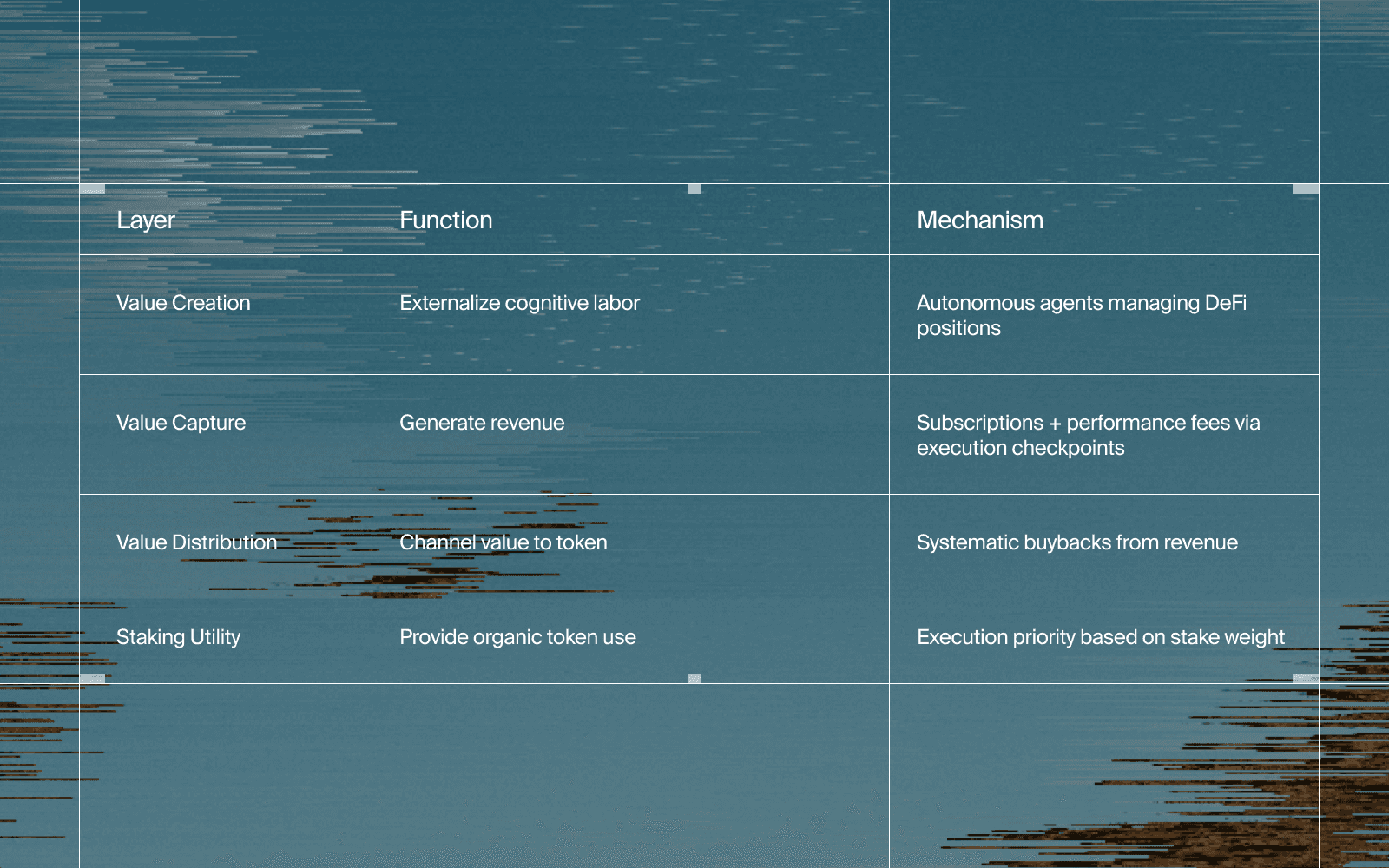
The system avoids common failure modes:
No cannibalization: Premium features and staking provide different value
No artificial scarcity: Priority allocates real contention, not manufactured bottlenecks
No speculation dependency: Token value flows from product usage, not promises
No governance theater: Scope is calibrated to decisions that benefit from distribution
This is how value flows through an agentic system: users deploy capital, agents generate returns, fees capture a share, buybacks channel value to the token, staking provides utility, and the flywheel compounds.
This document describes the architectural direction for Giza economics. Specific parameters—buyback ratios, priority formulas, fee structures—are subject to calibration based on empirical data and continued design work.
Risks & disclosures – Yield is variable and not guaranteed. DeFi carries smart-contract and protocol risks.
Review docs, audits, and your jurisdiction’s regulations before using Arma. Not investment advice.
© 2025 Gizatech AG